
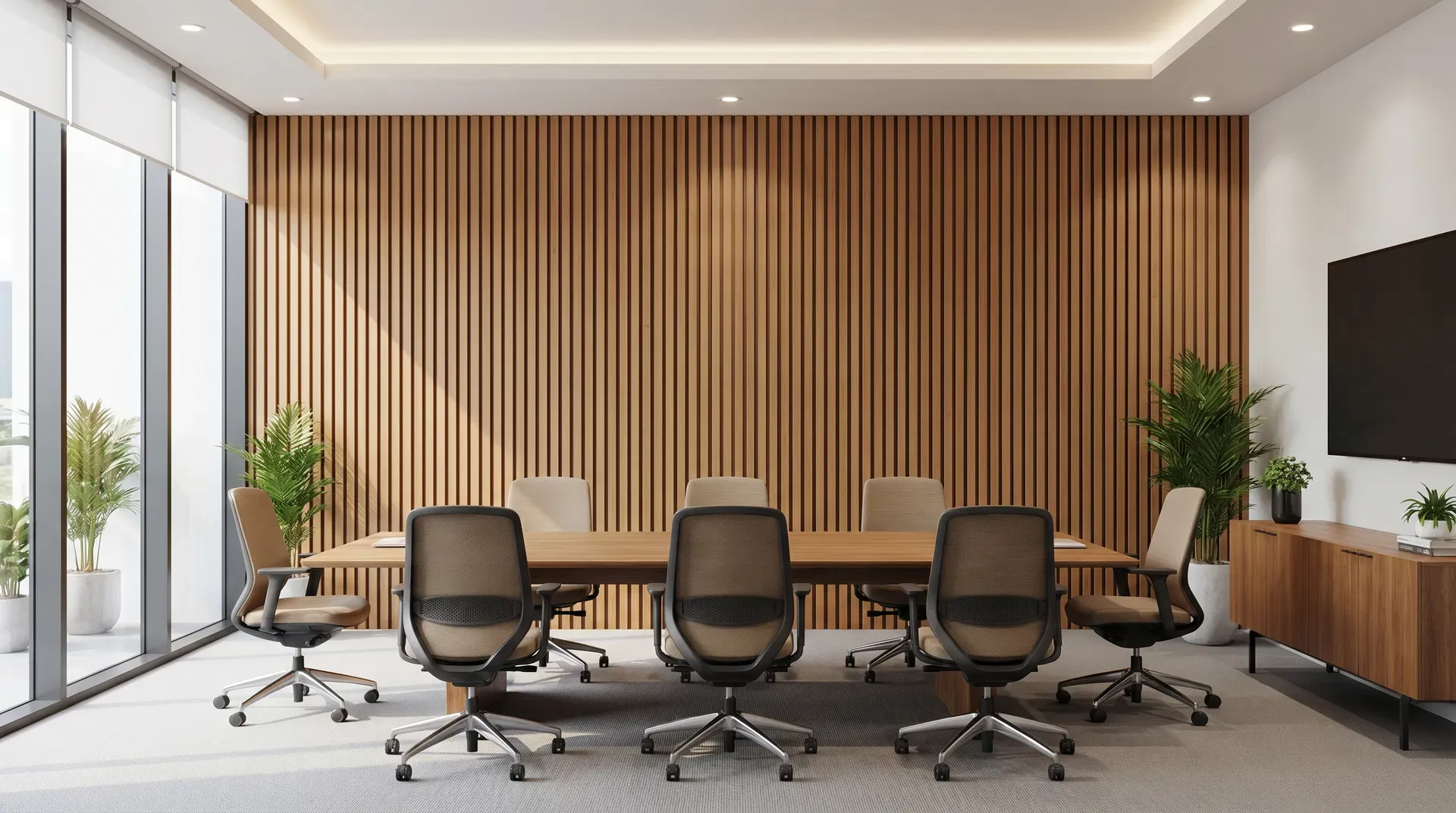
Overview
Meeting-room acoustics involve speech clarity, room reverberation, conferencing equipment and privacy between spaces. MDF slat acoustic assemblies may be one part of the design. Select products from applicable test evidence and room requirements rather than expecting panels to solve every issue.
The Acoustic Challenge in Meeting Spaces
Reflections from hard surfaces can impair speech clarity, while microphones, loudspeakers, room geometry and equipment settings also affect calls. Assess these together. Sound travelling through walls, doors, glazing or services needs a separate isolation assessment.
Planning reverberation control
Use absorption data for the exact panel assembly to plan treated area and placement. Set a reverberation objective for the room and verify the result after installation where required. Neither the presence of felt backing nor a high NRC guarantees clear audio throughout a room.
Addressing flutter echo
Repeated reflections between parallel reflective surfaces can cause flutter echo. Appropriately placed absorption or other acoustic treatment may help; assess the actual reflection paths and remaining surfaces. Avoid promising that panels on one wall will eliminate every echo.
Design and Placement Strategies
Coordinate acoustic treatment with screens, lighting, ventilation, fire requirements and maintenance access. Ceiling installations need a product intended for that use and a designed support system. Specify the tested mounting and any cavity or infill rather than assuming a universal 50 mm construction.
- Walls: locate treatment using room geometry, reflection paths and usable surface area.
- Ceilings: confirm product suitability, safe supports and coordinated services before installation.
- Verification: match the full test mounting and assess the completed room and conferencing setup.