
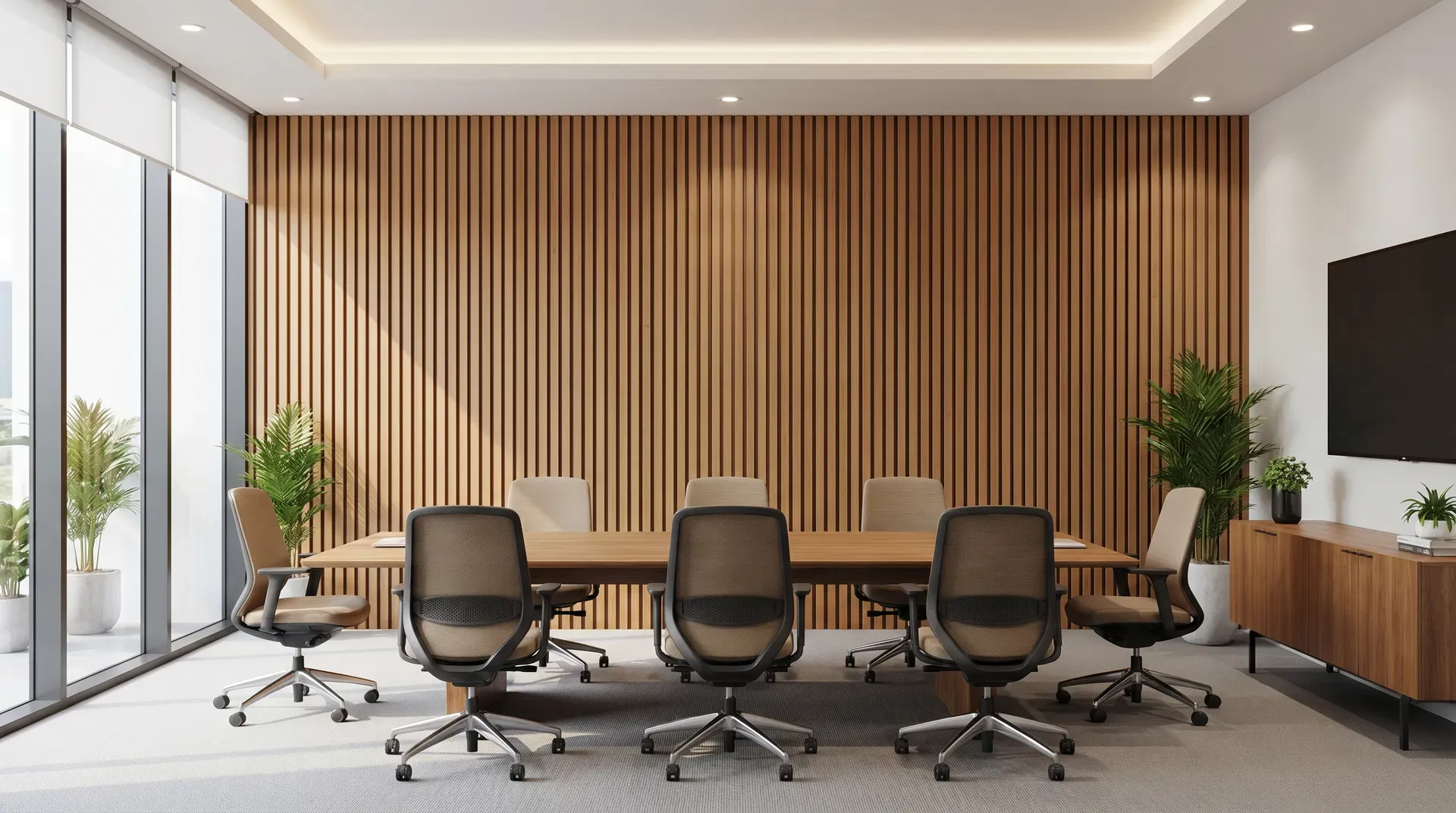
Overview
Conference rooms and boardrooms are the communication hubs of any corporate office. However, modern design trends favoring hard surfaces — glass walls, concrete floors, and large flat screens — create highly reverberant environments. This leads to poor speech intelligibility, echo during video calls, and a lack of acoustic privacy. MDF acoustic panels offer an elegant solution to these challenges.
The Acoustic Challenge in Meeting Spaces
In a conference room, sound waves from a speaker's voice bounce off hard surfaces, creating multiple overlapping reflections (reverberation). This smears the sound, making it difficult for listeners to understand speech clearly. Furthermore, excessive reverberation is picked up by microphones during video conferencing, resulting in a poor experience for remote participants.
Reducing Reverberation Time
The acoustic felt backing of MDF panels absorbs mid-to-high frequency sound waves — the range of human speech. By strategically placing these panels on the walls, the overall reverberation time of the room is significantly reduced, resulting in crisp, clear audio.
Eliminating Flutter Echo
Flutter echo occurs when sound bounces rapidly back and forth between parallel hard walls. Installing MDF acoustic panels on at least one of the parallel walls breaks up these reflections, eliminating the harsh, ringing echo that plagues many meeting rooms.
Design and Placement Strategies
MDF panels are favored in boardrooms because they provide high-end architectural aesthetics alongside acoustic performance.
- Feature Walls: Treat the main feature wall, often behind the presentation screen or opposite the glass partition.
- Ceiling Clouds: If wall space is limited, MDF panels can be suspended from the ceiling as acoustic clouds or baffles.
- Installation Tip: For maximum performance, install panels on battens with a 50mm air cavity filled with acoustic insulation to dramatically increase the NRC.